
The post-repair gap

Clean scan. Wrong alignment. Silent return to route.

After glass or body work, vehicles can leave the shop with a green ADAS dashboard and still be misaligned. NADIR closes the gap with shadow detection — telematics you already export, no ECU writes.

Shadow detectionPost-repair verificationSigned evidence
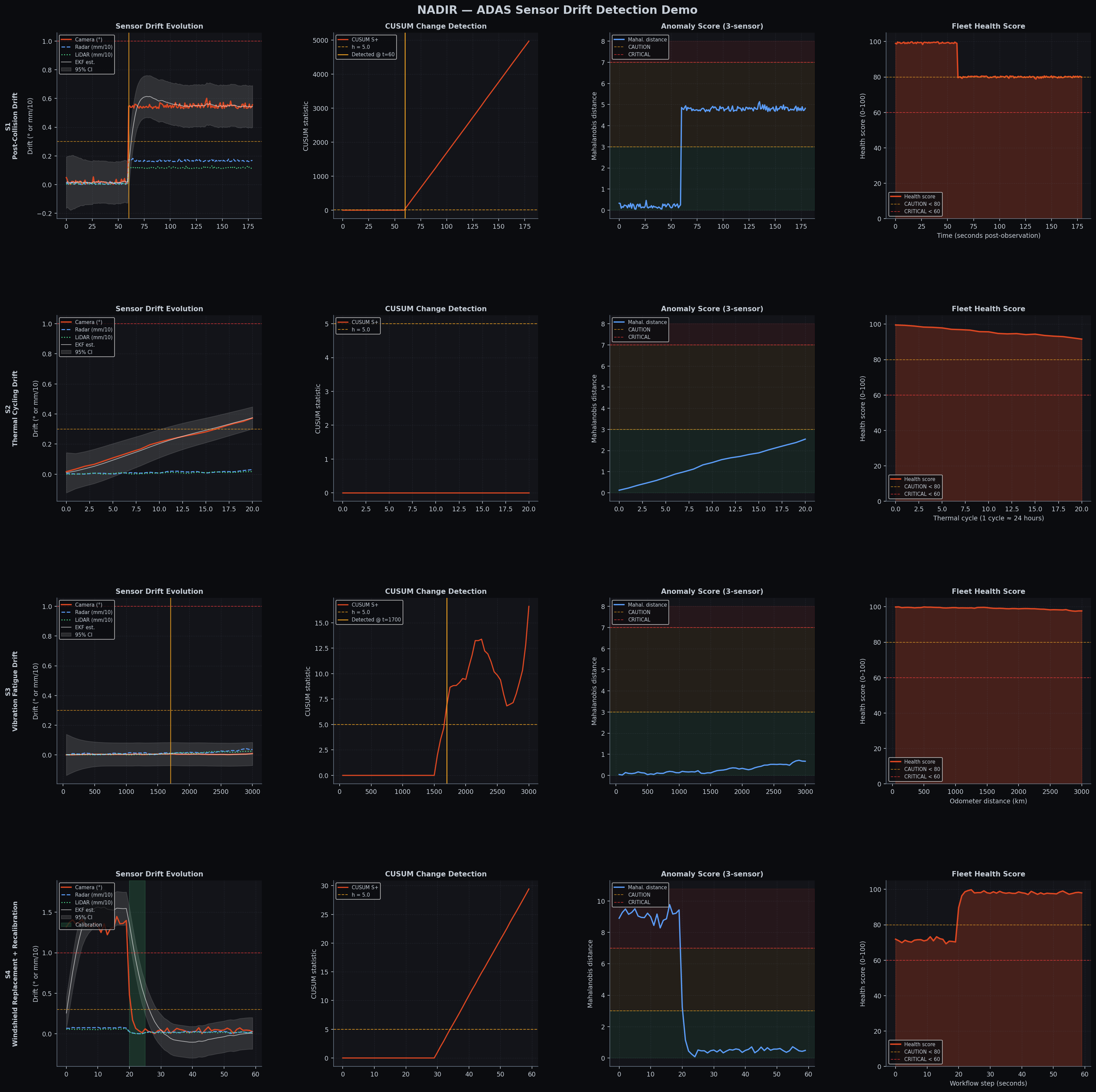
NADIR controlled ADAS drift dashboard
Controlled product output · not field performanceProduct / documented source
Pilot KPIMTTFF-REFlag within 7 days of repair
ModeShadow onlyNo ECU writes
EvidenceSigned bundlesInsurer-ready export
BoundaryAdvisory analyticsNot ASIL-certified
01 / INTERACTIVE DIAGRAM

MTTFF-RE timeline

Hours from RO close to first flag — illustrative cohort.

NADIR VISUAL · SEED DATAILLUSTRATIVE · NOT FIELD PERFORMANCE
Nominal Caution Critical

Illustrative seed-data visualization. Validate on your representative fleet sample before operational decisions.

02 / DETAILS

Two ways to read this page

Plain language for fleet and investor conversations. Technical detail for engineering diligence.

Plain-language summary

NADIR helps fleets detect likely ADAS miscalibration after repair using data you already export.

Shadow mode means advisory tiers and signed records — not automatic vehicle changes.

  • Start with a four-week $750 proof pilot.
  • Success = MTTFF-RE within seven days on most repair events.
  • Expand only after a written pass/fail readout.
03 / PROCEDURES

Windshield replacement and camera alignment risk

The most common post-repair ADAS gap in commercial fleets.

Windshield replacement disturbs forward camera bracket alignment more often than operators expect.

Static OEM scans at the shop may pass while dynamic lane keeping drift appears days later on highway routes.

NADIR watches dynamic residuals after RO close — not the scan receipt alone.

  • Tag RO procedure as windshield_replacement for stratum analysis.
  • Compare MTTFF-RE for glass vs structural repairs separately in readout.
04 / GOVERNANCE

Shadow mode and product boundaries

Every public NADIR deployment starts advisory. These boundaries protect fleet legal teams and set honest expectations for insurers.

Shadow mode means NADIR scores telematics, assigns NOMINAL / CAUTION / CRITICAL tiers, and exports signed evidence — without writing calibration parameters to the vehicle.

Your maintenance team decides whether to pull a unit, schedule a bay recalibration, or return it to route. NADIR does not override OEM safety controllers.

This is intentional: post-repair detection pilots should prove alert quality before anyone discusses automation or correction paths.

  • Console CRITICAL rows are recommendations, not work orders.
  • Weekly digest emails summarize CAUTION trends without paging on-call at 2 a.m.
  • Sample EVBs document what the model saw — useful for QA, not a legal verdict.
Actuation
None
Default mode
Shadow
ECU writes
Not supported in pilots
05 / PILOT KPI

MTTFF-RE — the one pilot metric

Mean Time To First Flag after Repair Event. One number for pass, fail, or stop.

When a vehicle leaves a glass or body shop, start a clock at repair order close.

MTTFF-RE measures hours until NADIR assigns CAUTION or CRITICAL in the post-repair observation window.

If most events flag within seven days, your maintenance team gets actionable lead time before silent misalignment becomes a safety conversation.

  • Median MTTFF-RE ≤ 168 hours is the default pilot target.
  • Pass rate ≥ 70% of in-cohort events is the companion statistic.
  • Events without telemetry are excluded — never counted as passes.
06 / DETECTION SCIENCE

Cross-modal residual scoring

How Pulse turns telematics into tiers after repair.

A green ADAS dashboard means self-check passed — not that alignment matches factory spec.

When camera lane proxy and radar range-rate disagree for days after glass work, that pattern elevates tier.

Single spikes from weather or harsh braking decay; persistence drives CAUTION and CRITICAL.

07 / OPERATIONS

Fleet maintenance operator guide

How to consume Console queue and weekly digest without alert fatigue.

Prioritize CRITICAL VINs with recent glass or ADAS module R&R.

Acknowledge rows in Console when bay inspection scheduled — feeds evidence workflow metadata.

09 / REFERENCE TABLE

Reference matrix — problem/post-repair-gap

Dense field reference for engineering diligence on this topic.

CategoryField / controlValueNotes
Pilotmodeshadow_advisoryNo ECU writes
PilotkpiMTTFF-REMedian ≤168h target
Pilotcohort50–150 VINsShadow Proof SKU
IngesttelemetryPOST /v1/telemetry/batchCSV/JSONL
IngestrepairPOST /v1/repair-eventsRO anchor
ScoretierNOMINAL|CAUTION|CRITICALPolicy-bound
Scoremodelpulse_residual_*Versioned
ProductqueueConsole CRITICAL rowsOperator-facing
ProductdigestWeekly CSV/emailCAUTION summary
EvidencesignatureHMAC-SHA256Integrity only
EvidenceverifyPOST /v1/evidence/verifyRecompute digest
SecuritytransitTLS 1.2+API only
SecurityauthBearer + API keyTenant scoped
BoundaryasilNot claimedAdvisory analytics
BoundaryactuationNoneShadow default
Commercialproof$750 flat4 weeks
Commercialops$750/moAfter pass
Commercialregional$15k+150–500 VINs
10 / GLOSSARY

Shared vocabulary

Terms used across NADIR pilots, API docs, and readouts.

MTTFF-RE

Mean Time To First Flag after Repair Event — hours from RO close to first CAUTION+ tier.

RO closed Monday 6pm, first CAUTION Wednesday 2pm → MTTFF-RE = 44 hours.

Shadow mode

Advisory scoring and evidence export without ECU writes or automated dispatch.

Console shows CRITICAL; maintenance decides whether to pull the unit.

EVB

Evidence Vehicle Bundle — canonical signed JSON record of tier transition lineage.

Includes model_id, policy_id, frame hashes, repair_event_id.

Pulse tier

Low-latency residual scoring tier used in public shadow pilots.

Batch scoring within minutes of telematics upload.

Cross-modal residual

Disagreement metric between sensor modalities (e.g., camera lane vs radar range-rate).

Persistent elevation after glass repair triggers CAUTION.

RO close

Timestamp when repair order is marked complete — starts post-repair observation window.

Must be UTC with timezone documented in data contract.

Policy ID

Version identifier for tier threshold rules separate from model weights.

policy_post_repair_glass_v3.2

Quarantine batch

Ingest batch rejected for schema errors — not silently partially scored.

Clock regression rows excluded with explicit error report.

Exhibit A

Week-four pilot chart plotting MTTFF-RE per repair event.

Median line vs 168h threshold.

Coverage exclusion

Repair event omitted from KPI due to missing telematics — not counted as pass.

Listed in readout appendix with reason no_telemetry.

Reason codes

Machine-readable tags explaining why tier was assigned.

CAMERA_RADAR_DIVERGENCE, POST_REPAIR_PERSISTENCE.

Adapter manifest

Versioned field mapping from fleet telematics export to NADIR schema.

geotab_pulse_v1.4.json
11 / DETAILS

Common questions

Straight answers for buyers and reviewers.

Common questions

Straight answers for buyers and reviewers.

12 / THE PIPELINE

Why the gap exists.

Static scans and dashboard greens do not prove dynamic alignment on route.

NADIR / DETECTION PIPELINEINGEST · SCORE · QUEUE · PROVE
01RepairGlass, bumper, mirror, ADAS module R&R
02ScanOEM static check may pass
03RouteDynamic lane/radar residuals drift
04GapFleet learns late — or not at all
13 / WHAT SHIPS

What changes with shadow detection.

Detection-first — not correction sales in week one.

01

Join RO close

Anchor post-repair observation window

02

Score telematics

Cross-modal residuals → tier

03

Queue CRITICAL

Maintenance inspects before heavy routes

04

Prove MTTFF-RE

One KPI in week four readout

Detect miscalibration before vehicles return to route.

4-week paid shadow pilot on 50–150 ADAS vehicles.