
Compares residual scoring against reference paths under windshield and yaw perturbations.
Public scorecard JSON enables third-party reproduction of charts.
Controlled figures, benchmark methodology, model boundaries, and reproducible product visuals for technical evaluation, not customer field-performance claims.
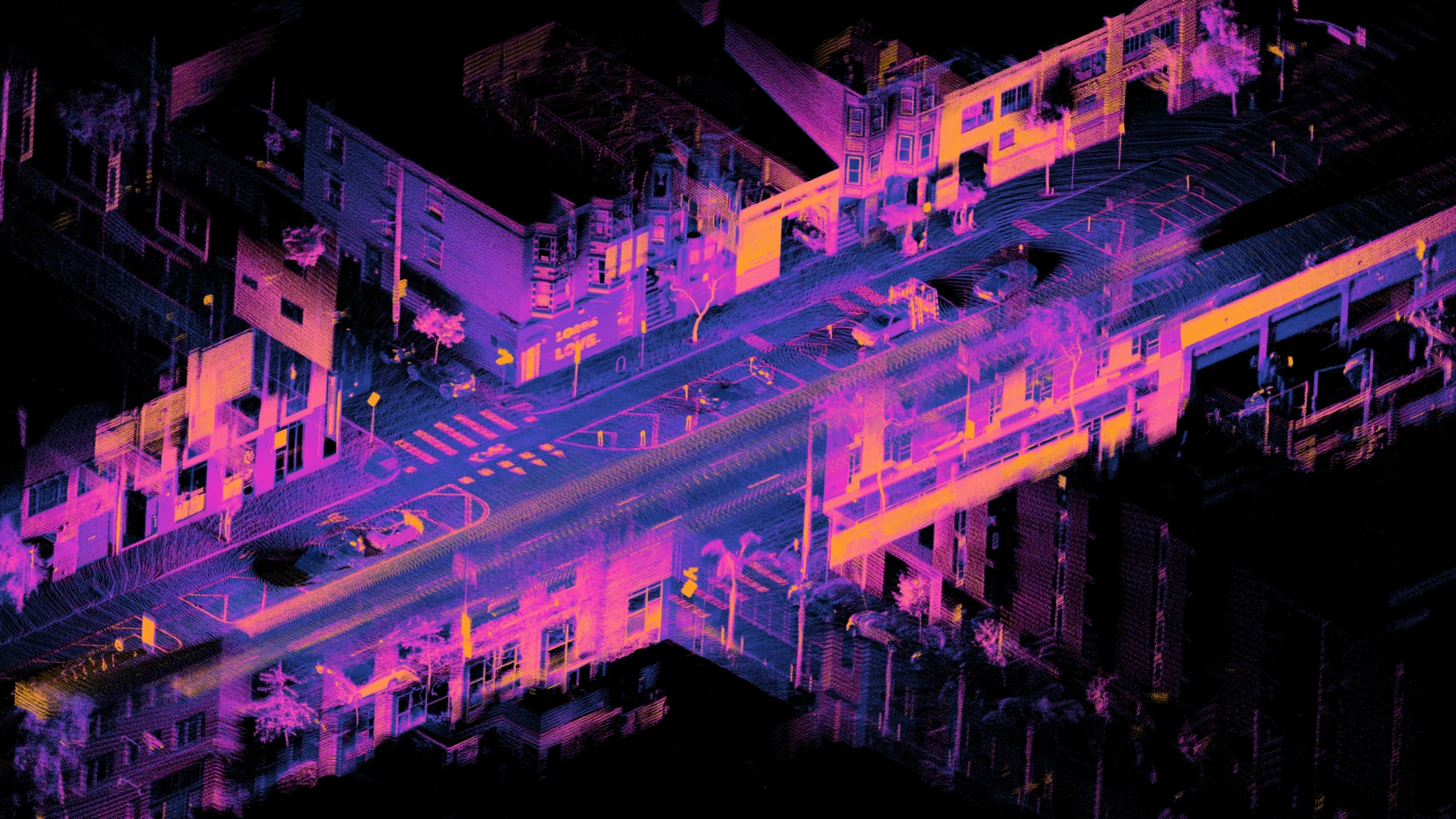
Controlled detection metrics — not field performance.
Illustrative seed-data visualization. Validate on your representative fleet sample before operational decisions.
Plain language for fleet and investor conversations. Technical detail for engineering diligence.
NADIR helps fleets detect likely ADAS miscalibration after repair using data you already export.
Shadow mode means advisory tiers and signed records — not automatic vehicle changes.
Batch ingest with schema validation, Pulse residual scoring, repair-event join, EVB export.
All outputs are versioned: model_id, policy_id, confidence, reason_codes.
Figures on this site illustrate detector behavior on seed and simulation data.
Mobileye overlay study compares residual scoring against reference paths under documented scenarios.
Do not extrapolate figures to field accuracy without your own pilot readout.
Figures illustrate methodology — not field performance guarantees.
Compares residual scoring against reference paths under windshield and yaw perturbations.
Public scorecard JSON enables third-party reproduction of charts.
Useful for comparing policy thresholds — not for quoting customer-specific detection rates.
Glass procedures differ from front-end structural repairs — strata prevent averaged misleading metrics.
Canvas modules on marketing pages use seed fixtures — labeled illustrative throughout.
Academic-style methods sections for research; MTTFF-RE readouts for customers.
How Pulse turns telematics into tiers after repair.
A green ADAS dashboard means self-check passed — not that alignment matches factory spec.
When camera lane proxy and radar range-rate disagree for days after glass work, that pattern elevates tier.
Single spikes from weather or harsh braking decay; persistence drives CAUTION and CRITICAL.
Pulse compares observed trajectories to a baseline envelope tuned for post-repair windows.
Outputs: tier, confidence, reason_codes[], model_id, policy_id.
Policies version independently from models — replay uses both IDs.
Sample CAUTION events with maintenance leads — label true vs nuisance.
Adjust observation window or procedure filters before week four readout.
Goal is actionable CRITICAL rate, not zero CAUTION.
Scoring window opens at RO close — pre-repair baseline excluded from post-RO residual.
Changepoint detectors flag abrupt shifts; sustained elevation drives tier transitions.
Cannot distinguish all root causes (wrong part vs skipped scan vs partial cal).
CRITICAL means inspect — not auto-assign blame to shop or OEM.
Every public NADIR deployment starts advisory. These boundaries protect fleet legal teams and set honest expectations for insurers.
Shadow mode means NADIR scores telematics, assigns NOMINAL / CAUTION / CRITICAL tiers, and exports signed evidence — without writing calibration parameters to the vehicle.
Your maintenance team decides whether to pull a unit, schedule a bay recalibration, or return it to route. NADIR does not override OEM safety controllers.
This is intentional: post-repair detection pilots should prove alert quality before anyone discusses automation or correction paths.
NADIR is not ASIL-certified software and does not replace OEM calibration procedures or static target rigs.
A valid evidence bundle signature proves integrity of the JSON record — not that the windshield camera is physically aligned.
Controlled benchmark figures on this site illustrate detector behavior on seed data; field accuracy requires your own MTTFF-RE readout.
If a vendor implies OEM sign-off from a dashboard alone, ask for the underlying evidence schema and pilot KPI.
After MTTFF-RE meets your SOW threshold, fleets may renew Shadow Ops ($750/mo) or open a regional evaluation ($15k+).
Correction, HORIZON forecasting, and tier upgrades remain internal or design-partner only until three paid shadow pilots complete.
Each expansion adds explicit contract language for data retention, rate limits, and excluded actuation paths.
NADIR provides advisory analytics on exported telematics correlated to repair order close timestamps.
Outputs include tier assignments, reason codes, and optional signed JSON evidence bundles.
Customer retains operational authority over vehicle dispatch and calibration vendor selection.
# SOW boundary snippet (illustrative)
scope:
  mode: shadow_advisory
  ecu_writes: false
  kpi: MTTFF-RE
  actuation: none
deliverables:
  - weekly_digest_csv
  - console_critical_queue
  - sample_evidence_bundles
- week_4_exhibit_a_chartThe commercial motion is a bounded $750 proof on 50–150 VINs with one KPI — easy for fleet CFOs to approve.
Shadow detection de-risks integration: no ECU access, no bay hardware, no ASIL claims.
Expansion revenue attaches to proven alert quality, not tier shopping in week one.
Mean Time To First Flag after Repair Event. One number for pass, fail, or stop.
When a vehicle leaves a glass or body shop, start a clock at repair order close.
MTTFF-RE measures hours until NADIR assigns CAUTION or CRITICAL in the post-repair observation window.
If most events flag within seven days, your maintenance team gets actionable lead time before silent misalignment becomes a safety conversation.
Join repair_events.ro_closed_at to health_transitions where tier ∈ {CAUTION, CRITICAL}.
Delta = first_flag_at − ro_closed_at in UTC hours.
Appendix lists excluded VINs with reason: no_telemetry, invalid_vin, pre_existing_critical.
SELECT
  re.vin,
  re.ro_closed_at,
  MIN(ht.scored_at) AS first_flag_at,
  EXTRACT(EPOCH FROM (MIN(ht.scored_at) - re.ro_closed_at))/3600 AS mttff_hours
FROM repair_events re
JOIN health_transitions ht ON ht.vin = re.vin
  AND ht.scored_at >= re.ro_closed_at
  AND ht.tier IN ('CAUTION','CRITICAL')
GROUP BY 1,2Each dot or bar is one repair event in the pilot cohort.
Color encodes pass (≤168h) vs fail. Gray marks excluded rows.
Median line is the primary SLA statistic; mean is shown but not contractual.
Cherry-picked VINs with perfect telematics while hard cases were dropped from cohort.
RO timestamps backfilled days after close — inflates MTTFF-RE artificially.
Treating missing data as NOMINAL instead of excluded.
NADIR readouts include an exclusion appendix specifically to prevent silent passes.
Define cohort size, date range, procedure types (glass, front-end, mirror), and telemetry coverage minimum.
State median and pass-rate thresholds explicitly. Define stop conditions if CAUTION noise exceeds agreed bounds.
Clarify that shadow mode continues regardless of pass — expansion is a commercial decision, not automatic actuation.
Dense field reference for engineering diligence on this topic.
| Category | Field / control | Value | Notes |
|---|---|---|---|
| Pilot | mode | shadow_advisory | No ECU writes |
| Pilot | kpi | MTTFF-RE | Median ≤168h target |
| Pilot | cohort | 50–150 VINs | Shadow Proof SKU |
| Ingest | telemetry | POST /v1/telemetry/batch | CSV/JSONL |
| Ingest | repair | POST /v1/repair-events | RO anchor |
| Score | tier | NOMINAL|CAUTION|CRITICAL | Policy-bound |
| Score | model | pulse_residual_* | Versioned |
| Product | queue | Console CRITICAL rows | Operator-facing |
| Product | digest | Weekly CSV/email | CAUTION summary |
| Evidence | signature | HMAC-SHA256 | Integrity only |
| Evidence | verify | POST /v1/evidence/verify | Recompute digest |
| Security | transit | TLS 1.2+ | API only |
| Security | auth | Bearer + API key | Tenant scoped |
| Boundary | asil | Not claimed | Advisory analytics |
| Boundary | actuation | None | Shadow default |
| Commercial | proof | $750 flat | 4 weeks |
| Commercial | ops | $750/mo | After pass |
| Commercial | regional | $15k+ | 150–500 VINs |
Straight answers for buyers and reviewers.
Straight answers for buyers and reviewers.
Regional fleets and repair networks proving post-repair ADAS detection first.
VIN, timestamps, telematics signals, and repair close times.
No. Shadow advisory only — detection, queue, and evidence export.
No. NADIR is advisory analytics, not safety-certified software.
Each figure is labeled as controlled research or simulation output and links to the relevant technical explanation.
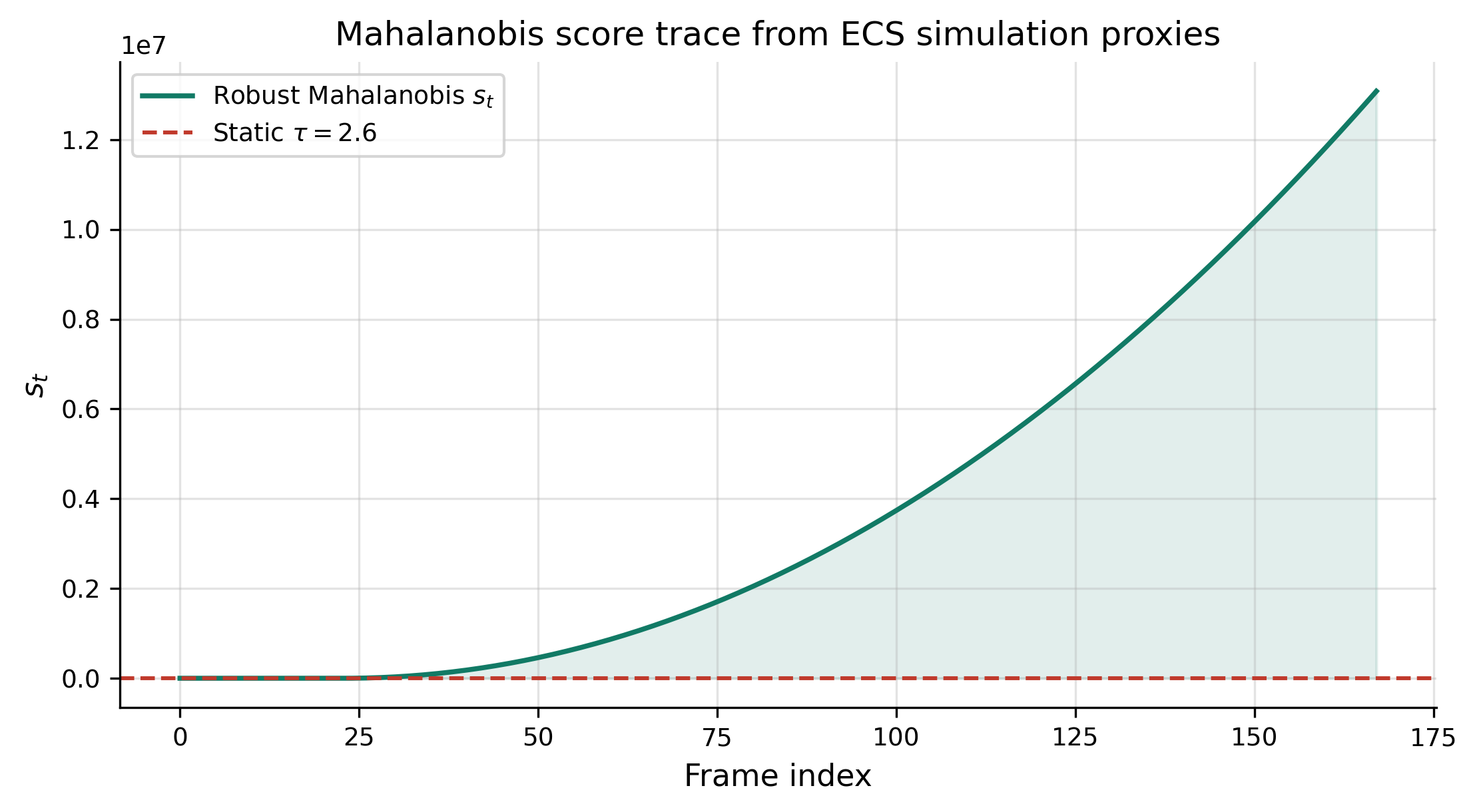 OPEN MODULEResidual traceNormalized drift statistic across a controlled sequence.Explore →
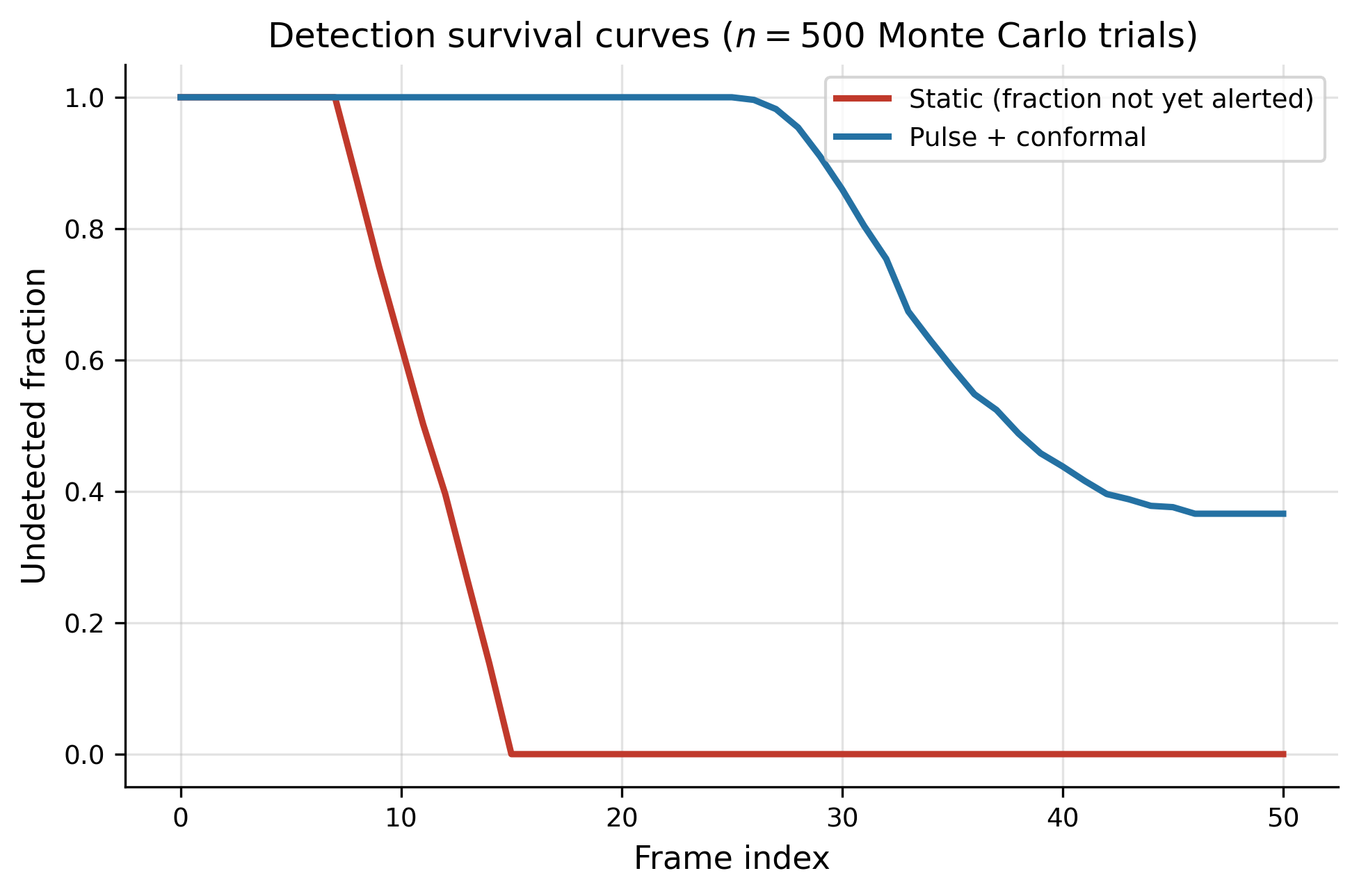 OPEN MODULEDetection survivalTime-to-detection behavior across model choices.Explore →
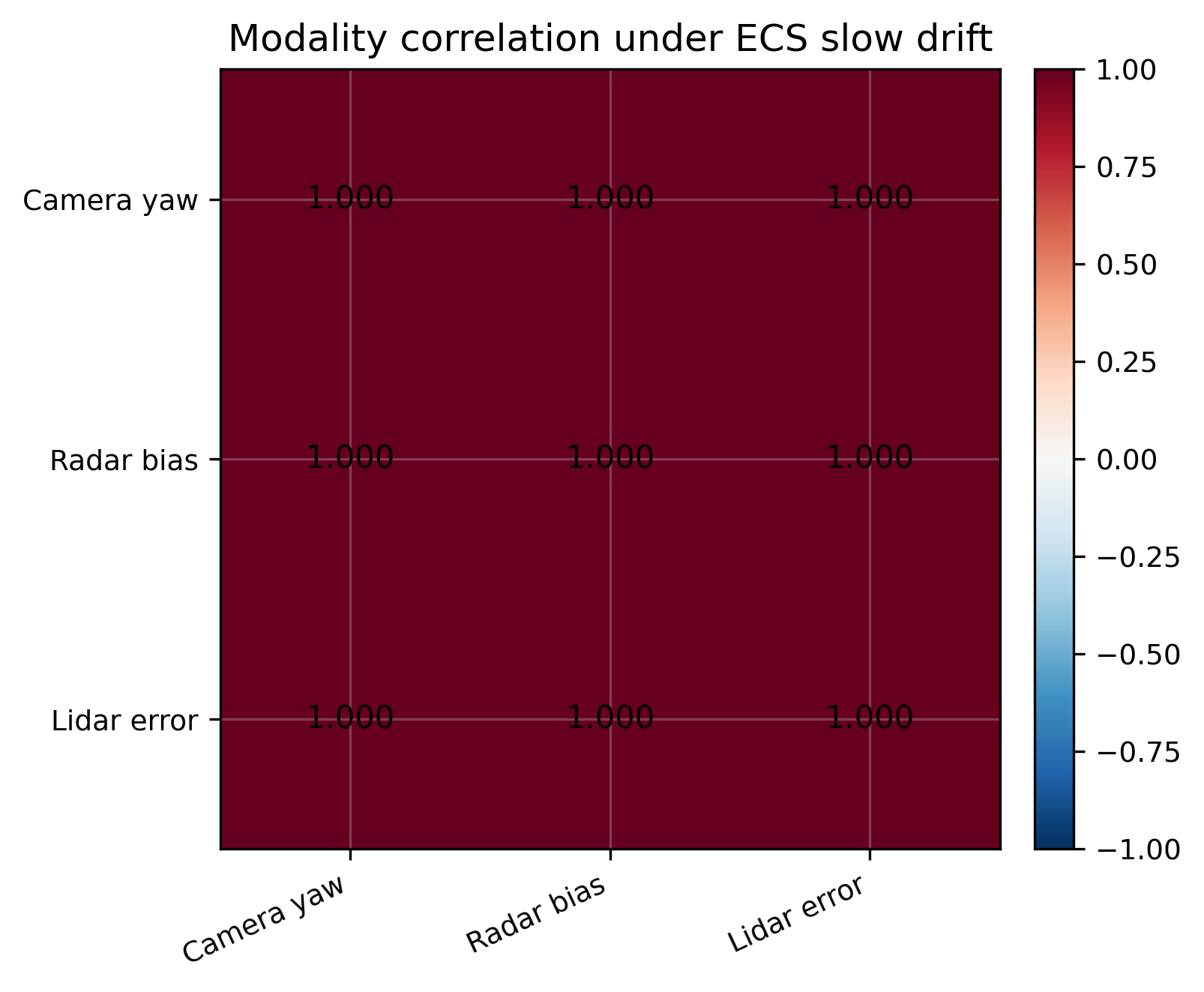 OPEN MODULEModality correlationCamera, radar, and proxy-signal relationships.Explore →
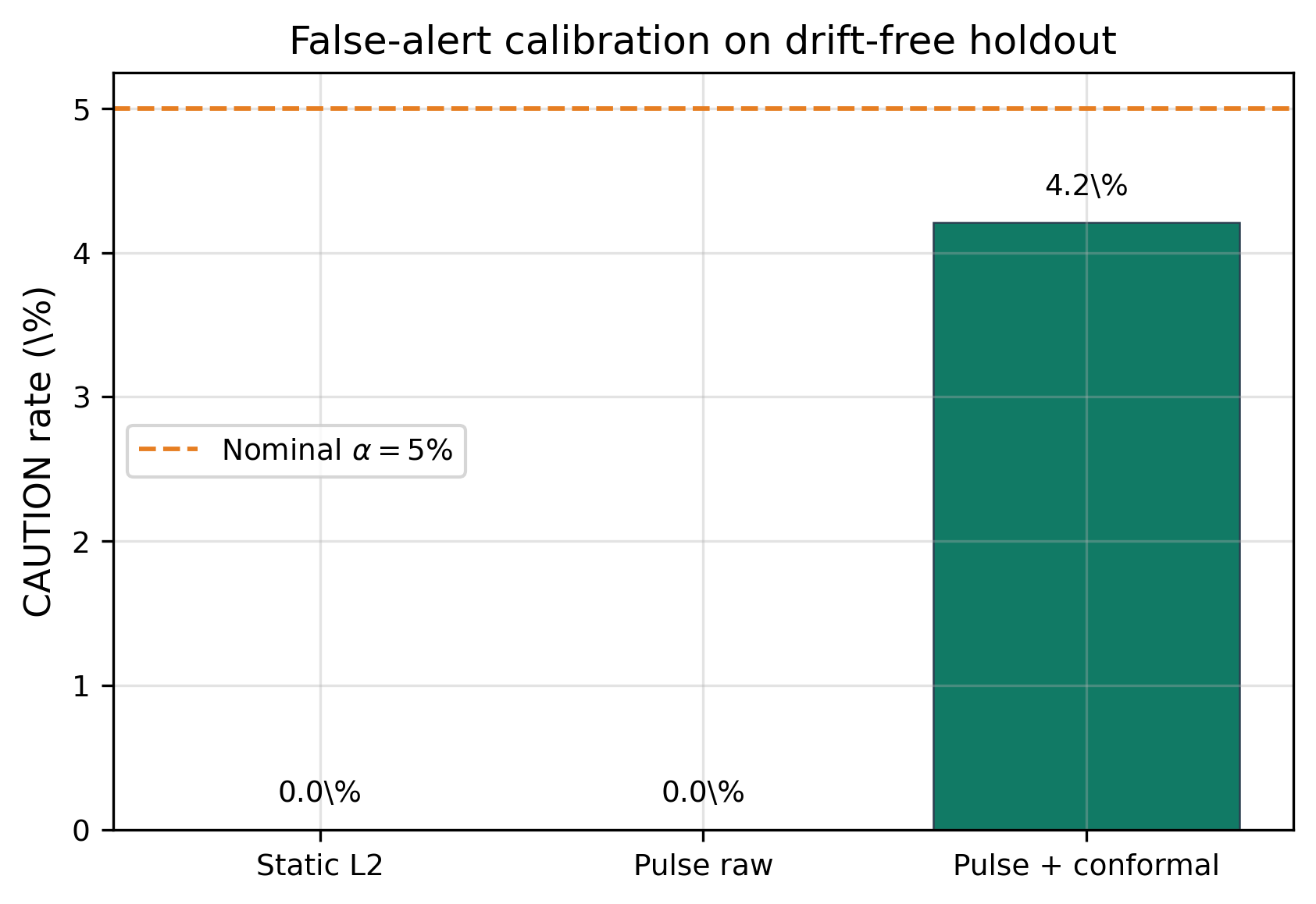 OPEN MODULEConformal FPRFalse-positive behavior by uncertainty stratum.Explore →
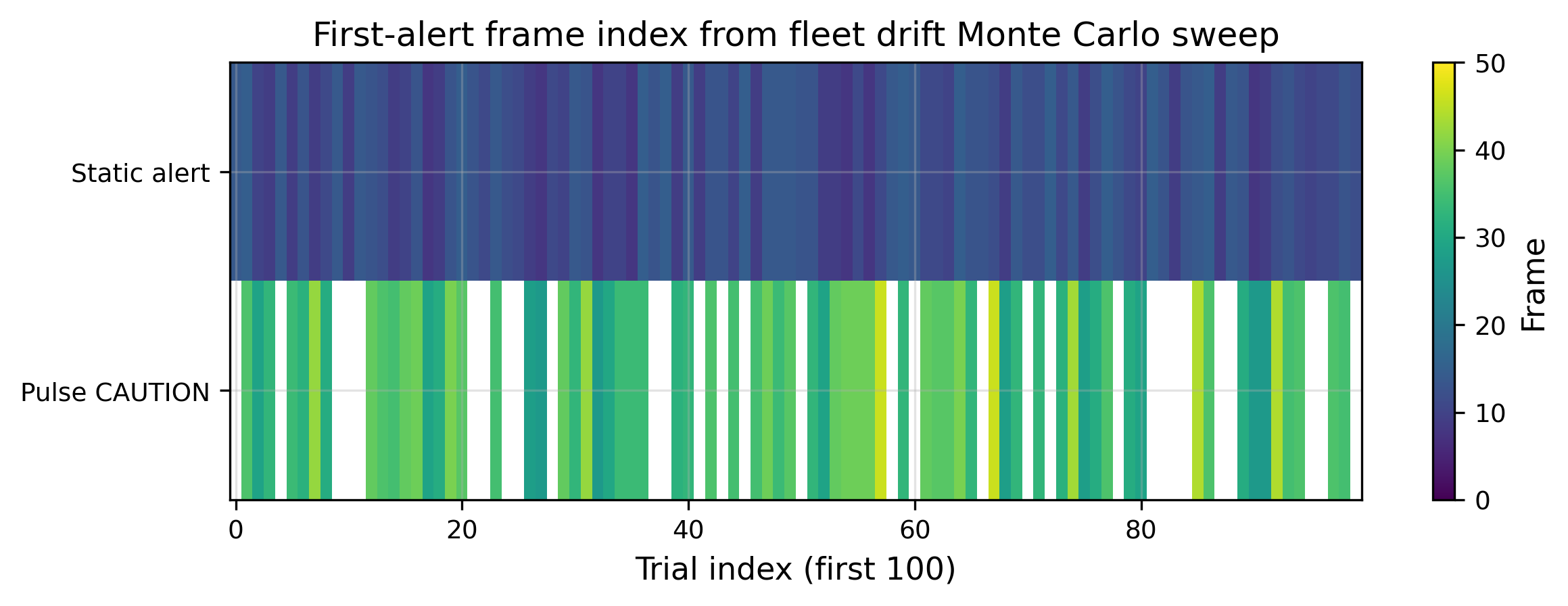 OPEN MODULEAlert heatmapFrames and scenarios that trigger detector response.Explore →
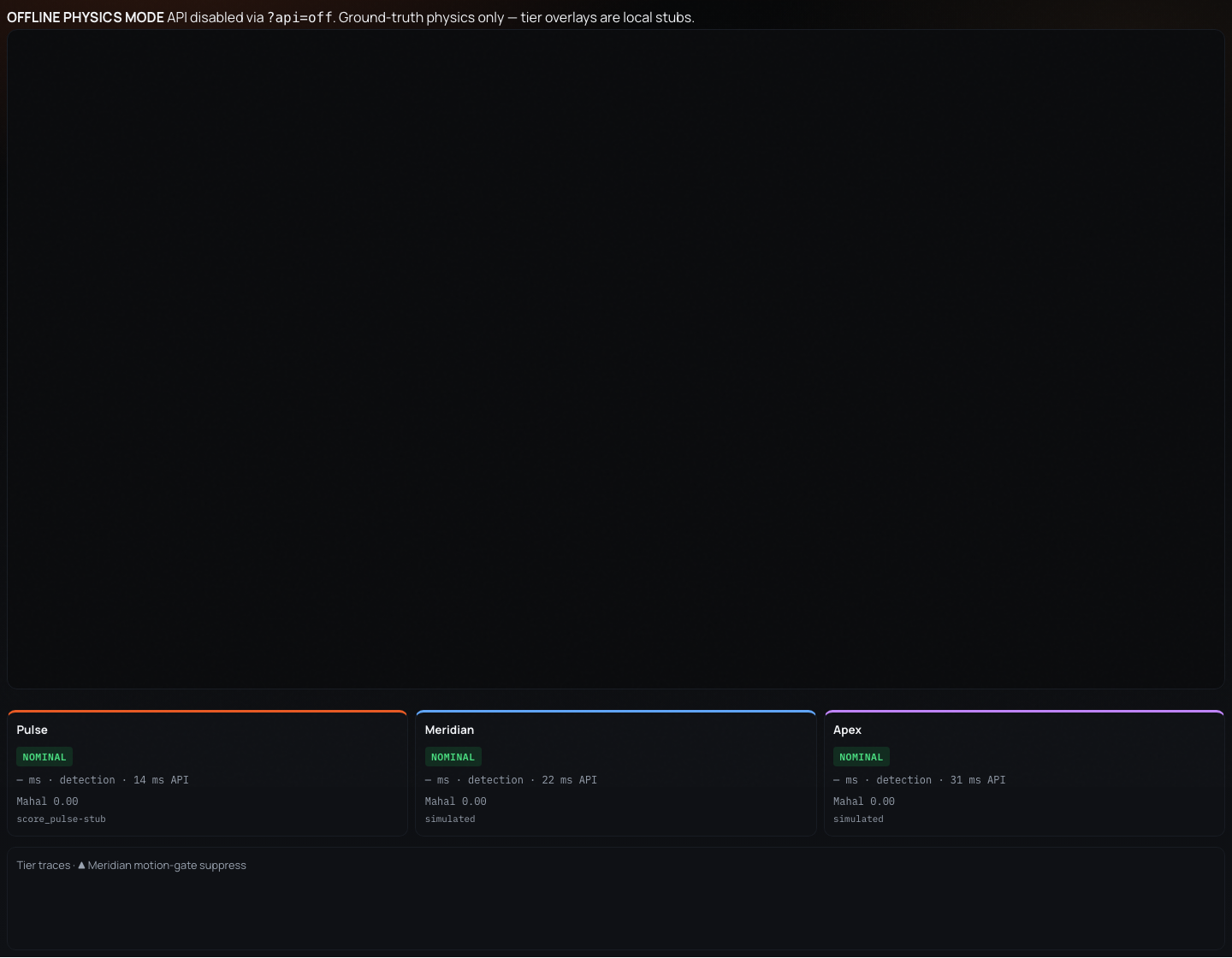 OPEN MODULETier comparisonPulse, Meridian, Apex, and Echo output depth.Explore →
NADIR separates source scenario, detector configuration, threshold policy, metric computation, and final interpretation.
Dataset, synthetic perturbation, or Calibration Lab event.
Sensor expectations, segment, tier, and model version.
Residuals, uncertainty, gates, and alerts.
Detection time, recall, false positives, and stability.
Artifacts, assumptions, limitations, and reproducible IDs.
The evaluation surface explicitly labels what each evidence type can support.
A technical evaluation should be able to move backward from the chart to the exact source and configuration.
Identify metric, units, sample, and comparison.
Open scenario, manifest, model, and threshold.
Run replay or Calibration Lab configuration.
Inspect limitations and alternative explanations.
Choose whether field validation is warranted.
Bring a dataset, sensor path, or operating question and preserve every assumption.